The Origin of the Symbol: Art as Resistance
The story of the watermelon as a symbol began in the wake of the 1967 Six-Day War. Following the conflict, the public display of the Palestinian flag (with its red, black, white, and green colors) was criminalized in the West Bank and Gaza. Even the mere combination of these four colors in art could lead to the confiscation of work or the arrest of the artist.
In the 1980s, a famous story emerged involving artists like Sliman Mansour, Nabil Anani, and Issam Badr. Legend has it that when an Israeli officer warned them that even painting a flower with those four specific colors was illegal, Badr reportedly asked, “What if I painted a watermelon?”
The officer’s dismissive response unwittingly gave birth to a legend. Since a sliced watermelon naturally contains all the colors of the flag—red flesh, black seeds, white rind, and green skin—it became a visual loophole. Palestinians began to use the fruit as a stand-in for the flag, a way to signal identity and solidarity without saying a word.
The Anatomy of the Design
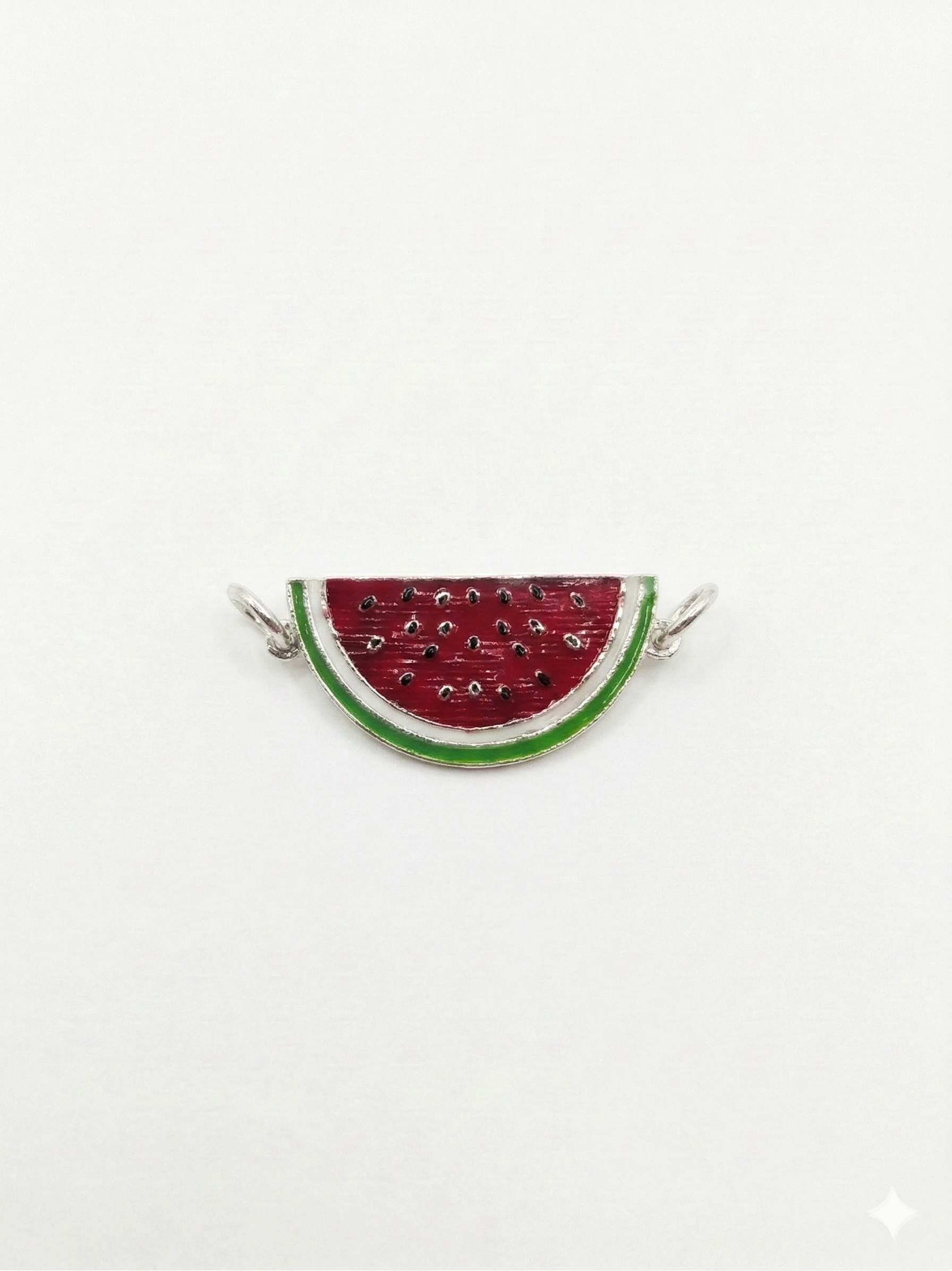
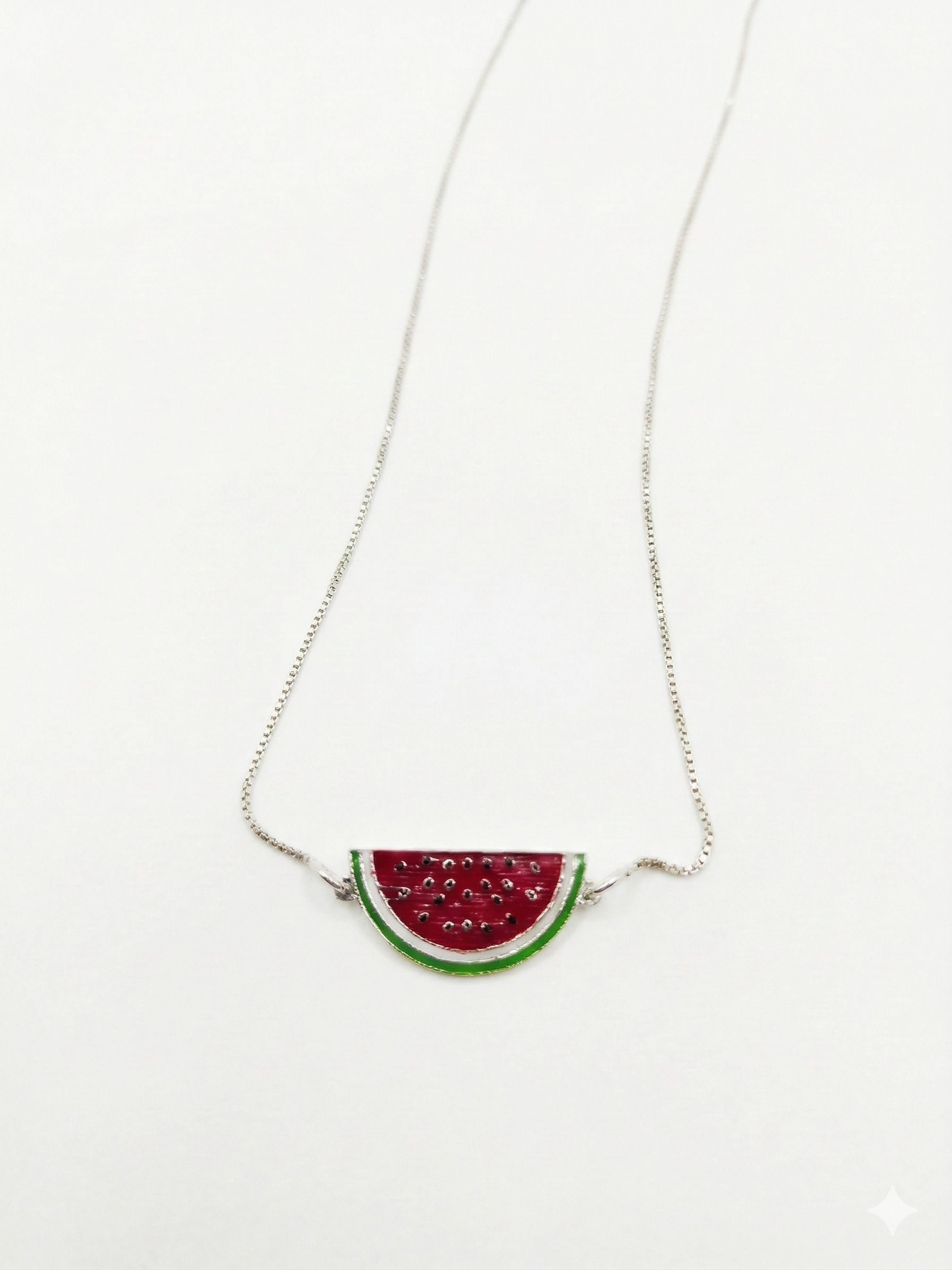
In this specific jewelry piece, the craftsmanship highlights the three distinct layers of the story:
1. The Crimson Core (The Red)
The deep red enamel of the fruit represents the heart of the land. In Palestinian culture, red is a color of vitality and sacrifice. By using a translucent or rich red enamel, the designer evokes the juiciness of the fruit grown in the plains of Jenin or the Jordan Valley. It is a reminder that the land is fertile and full of life, despite the hardships faced by those who tend it.
2. The Seeds of Memory (The Black)
The small black seeds scattered across the red center are perhaps the most poignant part of the design. Each seed can be seen as a person, a village, or a memory. Like seeds, the Palestinian people have been scattered across the globe in a vast diaspora, yet each seed carries the genetic code—the culture, the language, and the history—to grow back into a full tree if given the right soil. In jewelry, these black accents provide the “punctuation” to the story, grounding the vibrant red in a reality of persistence.
3. The Protective Rind (The White and Green)
The white and green layers form the boundary of the piece. The white rind represents the peace that is desired, while the green outer skin represents the connection to the earth and agriculture. For a people whose history is tied to the olive harvest and the tilling of the soil, green is a color of hope and “Sumud” (steadfastness).
A Modern Global Icon
While the watermelon symbol began as a local tactic to bypass censorship, it has evolved in the 21st century into a global phenomenon. In the age of social media, where algorithms sometimes suppress specific political keywords or flags, the watermelon emoji and artwork have resurfaced as a “digital loophole,” much like the physical fruit did in the 1980s.
This pendant bridges the gap between that historic struggle and the modern movement. When someone wears this watermelon slice in 925 silver, they are participating in a tradition of “subtle speech.” It is a piece that invites curiosity. It is not an aggressive statement, but a conversation starter. It says, “I know the story of this fruit, and I know the land it comes from.”
The Designer’s Touch: Silver and Permanence
By casting this symbol in silver, the designer takes a fruit that is ephemeral—something that rots and disappears—and makes it permanent. This is a metaphor for the Palestinian cause itself: though individuals may pass and seasons may change, the core identity remains as solid as metal.
The silver frame protects the enamel, ensuring the colors stay bright. In the world of jewelry design, silver is often associated with the moon and reflection. Here, it reflects the light of a culture that uses beauty to counter erasure.
Conclusion: The Sweetness of Freedom
Ultimately, the story of the watermelon pendant is a story of wit. It proves that you cannot ban a color, and you certainly cannot ban the fruits of the earth. It is a tribute to the Palestinian sense of humor and their ability to find beauty and symbolism in the everyday objects of their lives.
This slice of watermelon is a reminder that even in the most restricted circumstances, the human spirit will find a way to express itself. It is a tiny, wearable monument to the idea that some things—like the taste of home and the desire for identity—are universal and irrepressible.