

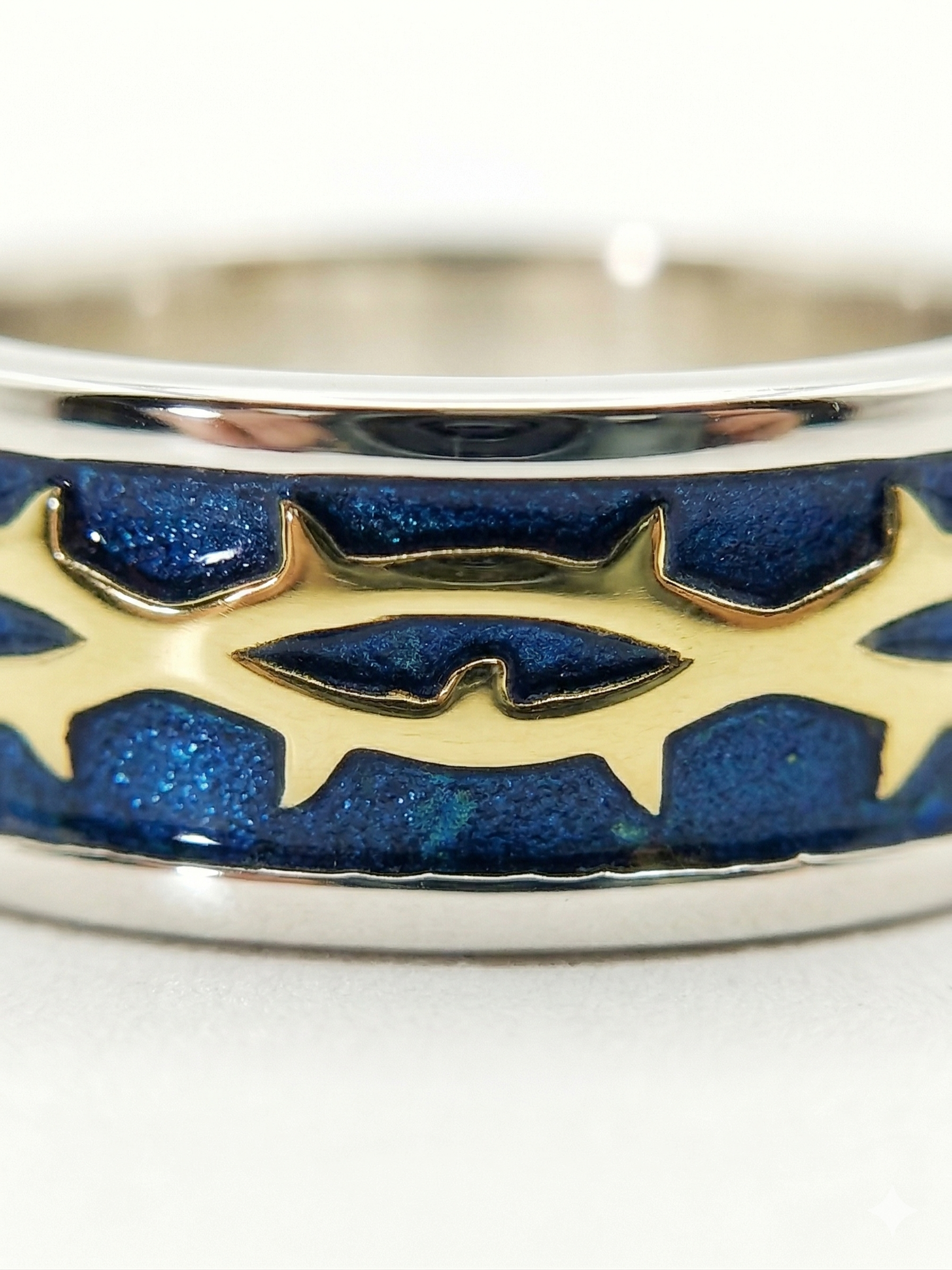

Crown of Thorns Ring With Enamel
The Origin: A Mockery of Kingship
The story begins in the early hours of a Friday in Jerusalem, roughly 33 AD. Jesus of Nazareth had been arrested and brought before Pontius Pilate, the Roman governor of Judea. The central accusation against Jesus was a political one: that he claimed to be the “King of the Jews,” a title that threatened the absolute authority of Caesar.
To the Roman soldiers stationed at the Antonia Fortress, this was an opportunity for cruel amusement. They did not just want to punish Jesus; they wanted to satirize him. If he was a king, he needed the regalia of royalty.
The Construction of the Crown
The soldiers gathered materials from the immediate area. While the exact botanical species is debated, many historians point to the Ziziphus spina-christi (Christ’s Thorn Jujube) or the Euphorbia milii, plants common to the region with long, needle-sharp spines.
-
The Robe: They draped a scarlet or purple cloak over his shoulders—the color of emperors.
-
The Scepter: They placed a reed in his hand to represent a royal staff.
-
The Crown: They twisted flexible, thorny branches into a circlet and pressed it firmly onto his head.
The “coronation” was a parody. The soldiers knelt before him, shouting, “Hail, King of the Jews!” before spitting on him and striking him on the head with the reed, driving the thorns deeper into his scalp.
The Theological Weight
In the Christian tradition, the Crown of Thorns is not merely an instrument of torture; it is a symbol of the “Great Exchange.” In the Book of Genesis, thorns and thistles are described as a curse brought upon the earth after the fall of man. By wearing the crown, Jesus is seen as literally taking the “curse” of the world upon his own brow.
Furthermore, it represents the inversion of power. While worldly kings wear crowns of gold and jewels to signify their dominance over others, the “Heavenly King” wears a crown of pain to signify his service to others.
The Journey Through History
After the Crucifixion, the Crown of Thorns vanished from the historical record for several centuries. It wasn’t until the 4th century, when Empress Helena (mother of Constantine the Great) began her pilgrimage to the Holy Land, that the “True Relics” of the Passion—the Cross, the Nails, and the Crown—were allegedly rediscovered.
The Byzantine Era
For centuries, the relic was housed in the Boukoleon Palace in Constantinople. It was the jewel of the Byzantine Empire’s collection. However, during the 13th century, the Empire fell into deep financial ruin following the Fourth Crusade.
King Louis IX and the Sainte-Chapelle
In 1238, the Latin Emperor of Constantinople, Baldwin II, was so desperate for funds that he pawned the Crown of Thorns to Venetian merchants. King Louis IX of France (later Saint Louis), a man of immense devotion, stepped in to “redeem” the relic.
The cost was staggering: 135,000 livres. To put that in perspective, the construction of the magnificent Sainte-Chapelle in Paris, which Louis built specifically to house the crown, cost only 40,000 livres. Louis greeted the relic barefoot and dressed in a simple tunic, carrying it into Paris with his own hands.
The Relic Today: Notre-Dame and the Fire
The Crown of Thorns remained in the Sainte-Chapelle until the French Revolution. During the reign of terror, many relics were destroyed, but the Crown was saved and eventually moved to the Cathedral of Notre-Dame de Paris in 1806 by Napoleon Bonaparte.
It is no longer a full “wreath” of thorns. Over the centuries, various popes and monarchs gifted individual thorns to other churches and rulers, leaving a circular bundle of rushes (parchment-like reeds) encased in a gold and crystal reliquary.
The 2019 Miracle
On April 15, 2019, the world watched in horror as Notre-Dame caught fire. As the spire collapsed and the roof burned, there was a desperate rush to save the cathedral’s most precious treasures. Father Jean-Marc Fournier, the chaplain of the Paris Fire Brigade, led a human chain into the burning building.
The Crown of Thorns was the first priority. It was successfully rescued from the treasury and moved to the Louvre Museum for safekeeping while the cathedral underwent restoration.
Symbolic Legacy in Art and Culture
The Crown of Thorns has fundamentally shaped Western art. In the early centuries of Christianity, artists often depicted Jesus as a triumphant figure. However, during the Middle Ages, there was a shift toward “Affective Piety”—an emphasis on the physical suffering of Christ.
-
Matthias Grünewald: His Isenheim Altarpiece depicts the thorns with gruesome, jagged realism, emphasizing human frailty.
-
Caravaggio: His depictions of the “Crowning with Thorns” use stark lighting (chiaroscuro) to highlight the psychological tension between the soldiers and their silent victim.
-
Literature: From T.S. Eliot to Dostoevsky, the “thorns” serve as a universal metaphor for the sacrifices required for redemption or the inherent pain of the human condition.








Reviews
There are no reviews yet.