


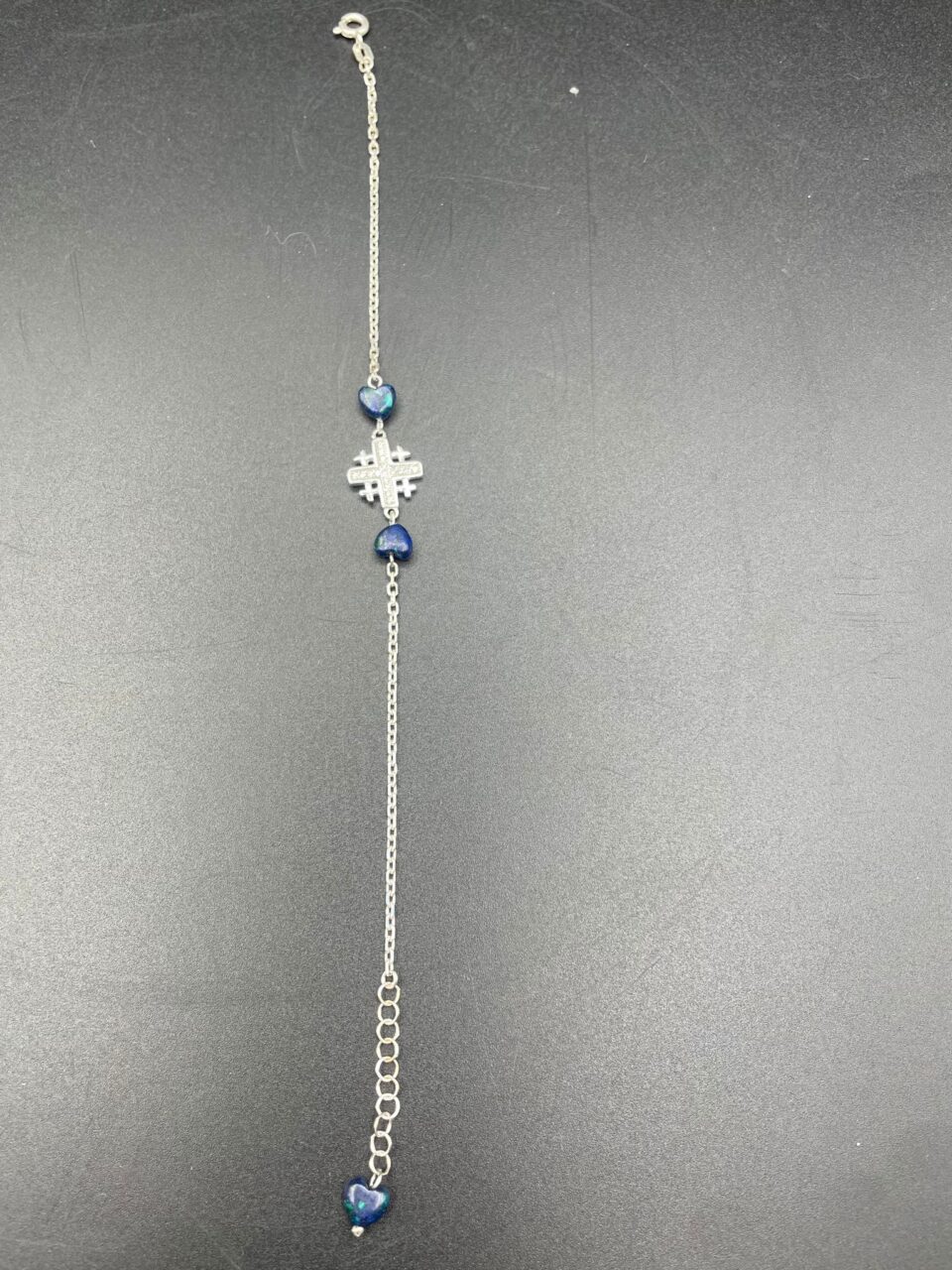
Silver Jerusalem Cross Bracelet (Customizable)
The Jerusalem Cross Story
Wearing the Jerusalem Cross isn’t just a trend, but also a deep symbolism, it is one of the most recognizable religious symbols in the world and is one of the central themes in Christianity.
Here are some interesting facts about it:
1- The central cross stands for Christ and the four smaller crosses stand for the 4 evangelists John, Luke, Mark, and Matthew.
2- The 5 crosses represent the five nations that figured in The Crusades: Great Britain, France, Spain, Germany, and Italy.

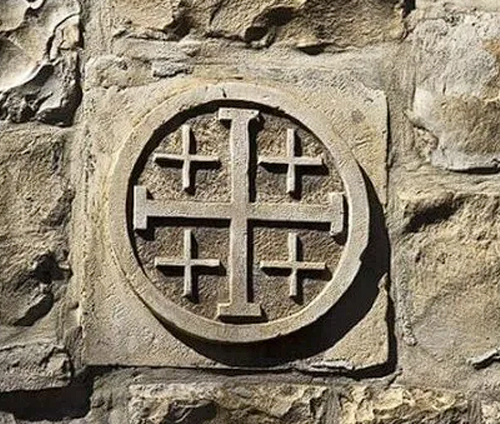
3- The large cross represents Christ as the strength at the center of Christianity and the smaller crosses as the 4 corners of the earth to which the faith spread.
4- The crosses represent the wounds that Christ suffered when He was crucified; the central cross for the wound on His side, and the 4 smaller crosses for the wounds on His hands and feet.
5- Crusaders used the Jerusalem Cross, displaying it on their papal banner from Pope Urban II. Godfrey de Bouillon, a leader in the Crusades, later adopted it as his personal coat of arms. He became the first ruler of Jerusalem after successfully driving out Muslims in the First Crusade (1099).
The Jerusalem Cross, also known as the Crusader Cross, is a distinctive symbol with deep historical and religious significance. It consists of a large central cross surrounded by four smaller crosses, one in each quadrant, creating a striking and meaningful design. The cross’s origins date back to the medieval Crusades, a series of religious wars initiated by Western European Christians to reclaim Jerusalem and other Holy Land sites from Muslim control. The design of the Jerusalem Cross is believed to symbolize the spread of Christianity from Jerusalem to the four corners of the world, reflecting its role as a Christian emblem of faith and pilgrimage. The central cross represents Christ’s sacrifice and the heart of Christianity, while the four smaller crosses are often interpreted as the four Gospels—Matthew, Mark, Luke, and John—or as symbols of the four directions, emphasizing the universality of the Christian message.
Historically, the Jerusalem Cross was adopted as a symbol of the Kingdom of Jerusalem, established after the First Crusade in 1099. The Kingdom of Jerusalem was a Latin Christian kingdom established in the Levant, and the cross became a heraldic emblem of the Crusader states. It was featured on banners, seals, and coinage, serving as a rallying symbol for Crusaders and Christian pilgrims traveling to the Holy Land. Over time, the Jerusalem Cross also came to represent the Christian presence in the Holy Land, symbolizing faith, hope, and the spiritual journey of pilgrims.
In the modern era, the Jerusalem Cross continues to hold religious significance and is widely used by Christian organizations, particularly those associated with pilgrimage, Holy Land ministries, and the Catholic and Orthodox churches. It is often seen on religious jewelry, vestments, and church decorations, serving as a reminder of the Christian mission to spread the Gospel and the importance of Jerusalem as the spiritual center of Christianity. The cross also appears in logos and emblems for various Christian charitable and missionary groups that work in the Holy Land and beyond, emphasizing themes of peace, reconciliation, and faith.
The symbolism of the Jerusalem Cross extends beyond its historical context. Its design encourages reflection on the Christian call to evangelism and service, as well as the unity of the Church across different cultures and nations. The four smaller crosses can also be seen as representing the four evangelists or the four cardinal virtues—prudence, justice, temperance, and fortitude—highlighting the moral and spiritual virtues that underpin Christian life. The cross’s bold, geometric form makes it a powerful visual symbol that resonates with believers and non-believers alike, often inspiring a sense of history, faith, and hope.
In contemporary culture, the Jerusalem Cross is sometimes used as a symbol of peace and reconciliation in the Middle East, representing the hope for harmony among different religious communities. Its universal message of spreading faith and love continues to inspire many, making it a timeless emblem of Christian identity and devotion. Whether seen in religious ceremonies, art, or jewelry, the Jerusalem Cross remains a powerful reminder of the Christian pilgrimage, history, and the ongoing quest for spiritual unity and peace in a complex world.
In conclusion, the Jerusalem Cross is not just a decorative symbol but a profound emblem rooted in history, faith, and the Christian mission. Its rich symbolism and historical significance make it a meaningful representation of Christianity’s spiritual journey and its enduring hope for peace and unity in the Holy Land and the wider world.




Reviews
There are no reviews yet.